Interpersonal Conflict
Armies locked in combat on a battlefield was not the only form of violence present in the Middle Ages. One on one confrontations enabled individuals to resolve interpersonal conflicts, and often involved the use of weapons. Duels were one method of resolving conflicts, and may have been fought due to an insult, enmity, or to defend one's honour from an accusation. These weapons were generally designed for close-range combat; it’s rare that an individual would have pulled out a crossbow to shoot their opponent.
Furthermore, daggers and stilettos, were often carried by individuals in everyday contexts; given their smaller size, they were both more practical to carry and less costly to purchase. They could be carried either covertly or openly, depending on the owner's intention and the weapon's appearance. For instance, if one intended to murder an old rival, hiding a stiletto in one's clothes allows them to approach their target without them seeing the weapon. Alternatively, if someone were a wealthy nobleman who purchased an elaborately carved dagger, they would carry it around their waist to display publicly. As such, these weapons could serve as tools of destruction or objects of display, and this intent could be indicated by how they were carried.
In the case of an attack or robbery, having a weapon nearby for defence is useful; however, a large weapon would be bulky and too heavy to constantly carry around, and so smaller bladed weapons were preferred. Similarly, these weapons could be carried to commit such crimes. Essentially, weapons were used in everyday, personal encounters, in addition to solely on far-off battlefields. Violence and the need for self-defence in the Middle Ages (and in general) could often occur close to home.
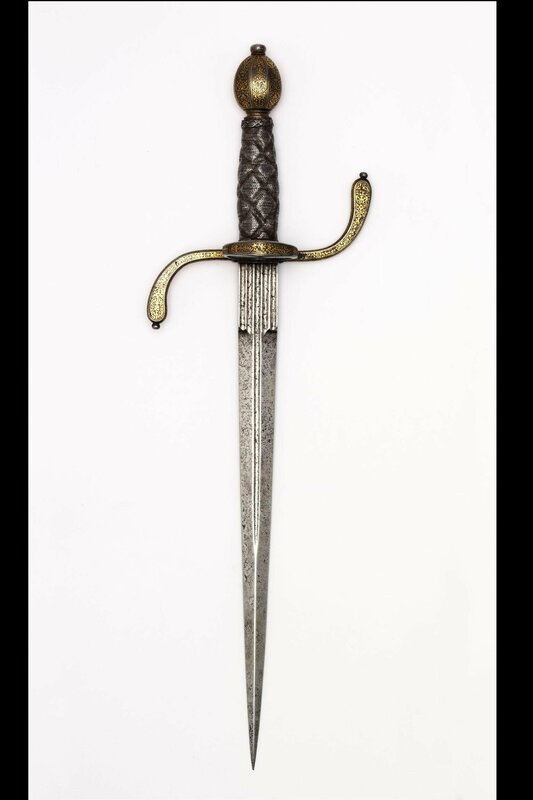
The purpose of this dagger was to aid its user in a fight. Unlike a battle, a duel is an interpersonal conflict, generally between two people. This could be used not only to protect oneself in the case of an attack or robbery, but as a weapon in a fight to defend one’s honour, thereby a secondary means of self-defence. This dagger was designed to pierce clothing, rather than armour; as such, this dagger proves that not all Medieval weapons were intended for the battlefield.
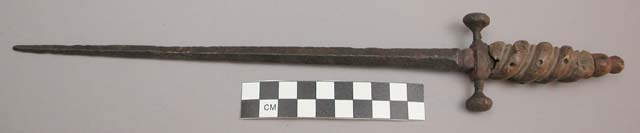
As a small, easily hidden blade, one of the stiletto’s first uses was by Medieval knights to pierce an opponent's chain mail or visor. However, it became popular for the purposes of self-defence and crime in the Late Middle Ages and Early Modern period. Its size rendered it easy to carry and conceal, and due to its sharp point and square or triangular blade, the stiletto was able to pierce clothing and small gaps in armour alike. It was used in many instances of crime, assault, murder, and assassination, even earning the nickname of "The Assassin's Weapon".
To see various fighting techniques suited to the dagger and stiletto based on historical fighting manuals, click here.
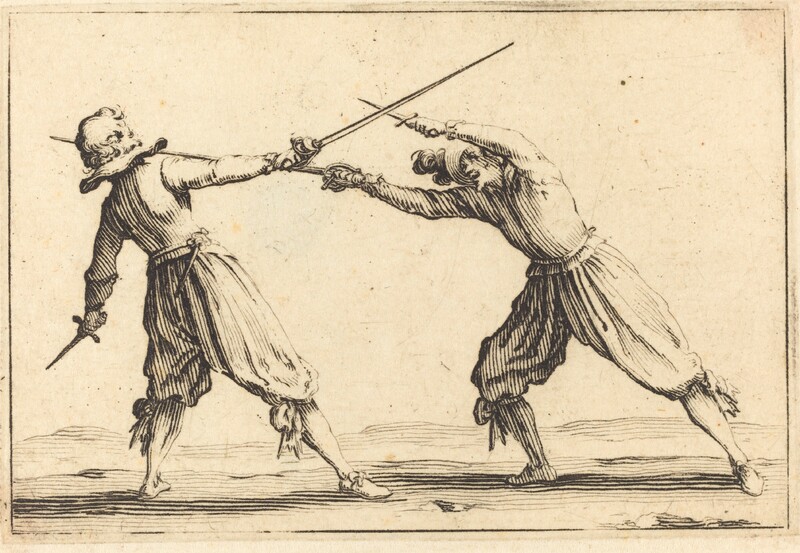
Contemporary to the Renaissance, this etching, created by French artist Jacques Callot (1592 - 1635), depicts two men duelling. Neither man is wearing armour, indicating that this is a personal conflict. In their right hands, they each hold a sword, and in their left hands, they hold a dagger. The man on the right parries the man on the left's sword with his dagger, a common fighting technique. The man on the left's dagger's sheath is clearly visible at his waist, showing that before the duel, he had been openly carrying his dagger.